Skip to content

OMNI SELLER CONSTELLATION

Less to look at.
More to act on.

Your channels already produce the data. Constellation reads all of it — Amazon, Target Plus, Nordstrom, Shopify, every marketplace and DTC site you sell through — on one contribution-margin basis and runs the same checks every week and every month. What comes back is a short list: the media, listing, restock and assortment changes worth making, with the evidence attached.

Built by marketplace operators. Running on live brand data across Amazon, Target, Nordstrom, Shopify, and more.

The problem

You have more data than decisions

The numbers already exist and don't agree.

Ad consoles, retailer portals, your storefront and finance each report performance with their own definitions, their own attribution and their own blind spots. The data is there. Reading it on one basis is still someone's job.

Nothing tells you which numbers matter this week.

Every dashboard shows everything. Another login, another set of charts, and the question “so what do we change?” still lands on someone's desk on Monday morning.

ROAS is graded without a floor.

A 5× ROAS can lose money on one retailer and make money on another, depending on price point, return rate and shipping cost. No ad console knows that. Omni Seller Constellation does. Without that floor, budget scales what looks efficient.

Execution waits for analysis that never gets scheduled.

Sales, returns, commission, shipping and media need to be reconciled before you can decide what to change. That work happens after the month closes, after the budget already moved.

Root Cause Analysis

A sales decline can come from lost availability, a listing issue, a price change, weaker traffic or lower conversion. Separate dashboards show the symptom; tracing the likely cause means reading those signals together before deciding what to fix.

Understanding Incrementality

Attributed sales aren't always additional sales. A campaign can take credit for demand that would have arrived anyway, or move it between channels. Understanding what actually grew requires looking beyond ROAS to total sales, organic demand and contribution.

Contribution to Channel Flywheel Dynamics

Media, conversion, organic visibility and in-stock availability interact. A budget or assortment decision needs to consider how it may affect the rest of the channel, alongside immediate contribution. Is it supporting profitable growth, or paying to mask a problem elsewhere?

Style-Level View Alongside SKU-Level Detail

SKU-level reporting can bury the commercial story in sizes, colors and channel-specific identifiers. A style-level view brings those variants together across retailers, while SKU detail shows exactly which size, color or listing needs attention. You need both to make the right assortment and restock calls.
Meet Omni Seller Constellation

Repeatable by design
Weekly moves. Monthly decisions. Margin you can trace to both.

Omni Seller Constellation does the work a full-time ecommerce director would do every Monday and every month-end, if they had the time. It normalizes sales, returns, inventory, pricing, advertising and channel terms onto a single product master, then strikes a full contribution P&L at any grain: company, channel, retailer, style or SKU. One style, side by side across every channel it sells on, at true margin — so you can see where it earns and where it's being carried.

Your channel dashboards stay where they are; Constellation reads them on one basis. What comes back is a ranked set of changes, each with the number behind it and the reasoning attached, and each figure stating how much of the catalog it covers.

The commercial picture

How Omni Seller Constellation narrows it down

Screens that run every period and surface only what fires

Where media is buying stockouts, not sales

Where efficient and profitable disagree

What to stop selling, and where

Which channel earns on the same product

Assumptions stated, so the recommendation can be trusted

What every dollar actually earns

The methodology

Recommendations you can defend in a board meeting

The method is frozen so a recommendation can be compared with last month's, not so the report looks tidy.

Unknown is never zero.

Coverage first.

Every analysis begins with a coverage check: which channels, which date ranges, which data families, which advertising upload windows. A date that no upload covers is unknown, never zero.

Frozen assumptions.

Constants such as resale rate, COGS basis and fee terms are versioned. Methodology stays still so performance can move. If an assumption changes, the change is declared and the prior period is restated on the new basis — otherwise the month-over-month delta means nothing.

Known variances, disclosed.

Where source systems disagree — duplicated return authorizations, inflated order counts, returns attributed to the wrong marketplace — the report shows the direction and magnitude of the variance instead of quietly correcting it.

Basis notes on every figure.

Every number in every report traces to a numbered note stating its source, its formula and its coverage.

From reporting to decisions

Not a dashboard. An operating rhythm.

Your channels already produce the data. Omni Seller Constellation reads it on a fixed cadence, using the same methodology and screens, and returns the few changes that matter this week and this month.

Every week

One page. One to three changes.

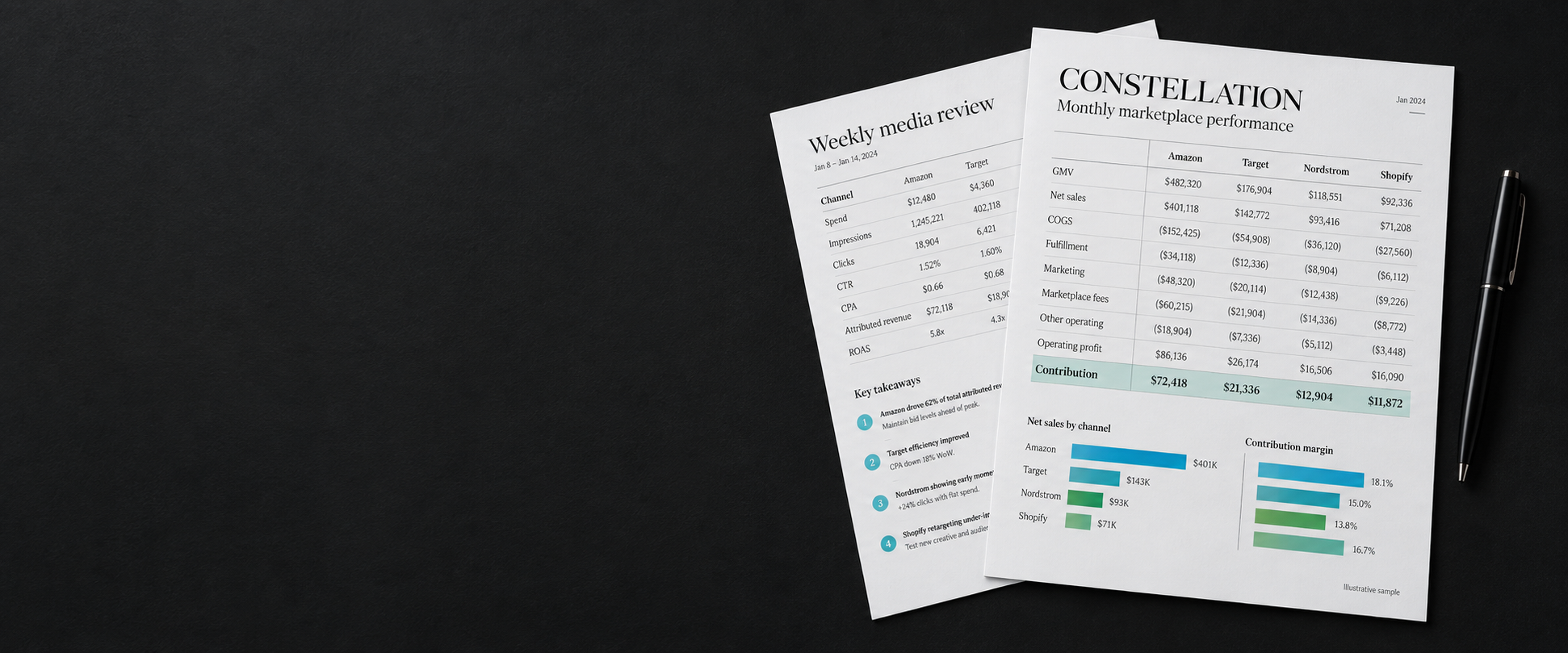
One page per retailer that ends in one to three changes for the week ahead: budgets to move, styles to pull media from, restocks needed before adding spend. Headline media KPIs, week-over-week trends, and campaign and style detail provide the evidence. Delivered as the Weekly Media Review.

Every month

One P&L. The decisions for the month.

The channel P&L plus the fixed screens, ending in the decisions for the month. Advertising KPIs and top styles ranked by revenue and by contribution sit side by side; the screens filter for revenue movers by channel, expensive revenue, negative-contribution media, under-invested winners, sub-1× spend, shipping burden, and stockouts holding back spend. Delivered as the Monthly Marketplace Performance Report.

Recommendations, not observations.

Every review ends in what to change and why. The screens and thresholds are the same every period, so this month's recommendation is comparable to last month's — and every recommendation is reviewed by your Omni Seller team before it reaches you.

What a month reduces to

The report that ends in an action

Illustrative sample

Fictional data, shown only to illustrate the report format. This is a contribution P&L excerpt, not a live brand report or a statement of product results.

OMNI SELLER CONSTELLATIONMonthly marketplace performance
Sample monthUSD · Cash lens · Basis v1

Fictional: 4 channels · 60 styles · 7 screens → 3 recommended actions

3 recommended actions · Fictional

Negative-contribution media: pull spend from two styles.

Expensive revenue: review Nordstrom returns before adding budget.

Under-invested winner: restock and fund one style.

The evidence underneath$73,39024.6% of net revenue [9]
Channel contribution P&L · Fictional USD figures
P&L lineAmazonTarget PlusNordstromShopifyTotal
Gross sales [1]120,00090,00080,00060,000350,000
Return reversals [2](12,000)(13,500)(20,000)(6,000)(51,500)
Net revenue [3]108,00076,50060,00054,000298,500
COGS, net of resale credit [4](32,400)(24,480)(24,000)(16,200)(97,080)
Outbound shipping [5](9,000)(7,650)(7,500)(5,400)(29,550)
Marketplace commission [6](16,200)(11,475)(12,000)0(39,675)
Return shipping [5](1,200)(1,350)(2,500)(600)(5,650)
Agency fees [7](3,240)(2,295)(1,800)(1,620)(8,955)
Media [8](18,000)(9,000)(10,000)(7,200)(44,200)
Contribution [9]27,96020,2502,20022,98073,390
Coverage & basis notes

Coverage: All figures are invented for one complete illustrative month across four USD channels. No customer data is used. Real reviews state source coverage, missing inputs and known variances before analysis.

  1. Gross sales: fictional channel sales before return reversals.
  2. Return reversals: fictional revenue reversed for returns occurring in the sample period.
  3. Net revenue: gross sales minus return reversals.
  4. COGS: illustrative unit costs of goods sold minus resale credits. No landed-cost accrual is included.
  5. Outbound and return shipping: illustrative order-level costs, aggregated per channel.
  6. Commission: fictional terms of 15% for Amazon and Target Plus, 20% for Nordstrom and 0% marketplace commission for Shopify; full commission refunds on returns are assumed. These are sample assumptions, not actual retailer terms. Shopify payment processing and subscription fees are outside this simplified excerpt.
  7. Agency fees: assumed 3% of net revenue across each channel.
  8. Media: fictional spend covering the entire sample month.
  9. Contribution: net revenue minus net COGS, outbound shipping, marketplace commission, return shipping, agency fees and media. Margin: contribution divided by net revenue, rounded to one decimal place. This is contribution under the stated basis, not net profit.

How it works

From four sources of truth to one

  1. Connect.

    Amazon Seller Central, Shopify, and Acenda — which fronts Target Plus, Nordstrom and other retail marketplaces. Advertising performance is loaded per channel. Unit costs and channel terms are entered on the product master.

  2. Reconcile.

    Channel SKUs are linked to one master product. Duplicate feeds are excluded. Non-USD marketplaces stay in their own currency on their own line — nothing is silently converted or double-counted.

  3. Reduce.

    The same screens run on schedule every week and month, using a frozen methodology. They return only what fired, reduced to the few changes to make with the evidence behind each.

  4. Act.

    Media budgets, restocks and assortment calls grounded in contribution rather than revenue — made by your team, or by Omni Seller's media managers on your behalf.

Who it's for

Built for brands that sell everywhere

Brand leadership

Leaders at mid-market consumer brands selling through three or more marketplaces and retailers, who want the few changes that matter each week without reading every dashboard.

Media teams

In-house or agency — who want ROAS read against margin, and who need to know when a scaled campaign is buying stockouts instead of sales.

Finance teams

Teams who want the reconciliation done once, on a stated basis, so the conversation can be about what to change rather than whose number is right.

A few more answers

Frequently asked questions

Is this another P&L or analytics tool?

No. Most brands already have the numbers. Omni Seller Constellation is the standing review that reads them on one basis and returns what to change. The P&L is the evidence, not the product.

Does Omni Seller Constellation replace my channel dashboards?

No. Seller Central, Shopify and your retailer portals remain the sources. Omni Seller Constellation reads them on one basis and runs the same screens every week and month, returning a short, ranked list of changes with the evidence attached.

Which channels are supported?

Amazon (every marketplace, each reported in its own currency), Shopify, and any retail marketplace fronted by Acenda — including Target Plus and Nordstrom. Additional channels are scoped per engagement.

Does it change my bids or budgets automatically?

No. Omni Seller Constellation returns the few budget and bid changes that the scheduled screens identify, with the number and reasoning behind each. The changes are made by your team or by Omni Seller's media managers — and every recommendation is reviewed by a person before it reaches you.

Is it self-serve?

Today Omni Seller Constellation is delivered through Omni Seller engagements. Brands outside the agency can request early access.

What happens to my data?

Your data is yours. Any benchmark work uses anonymized, aggregated figures only, is opt-in, and never includes customer PII.

Why “cash lens”?

Profit is struck against returns that actually occurred in the period, not against an assumed return rate. It is the harder number to argue with. An accrual lens is on the roadmap for brands that carry expected return rates on their product master.

Omni Seller Constellation

See what your channels reduce to.

Thirty minutes, your channels, and the first three things Omni Seller Constellation would tell you to change.